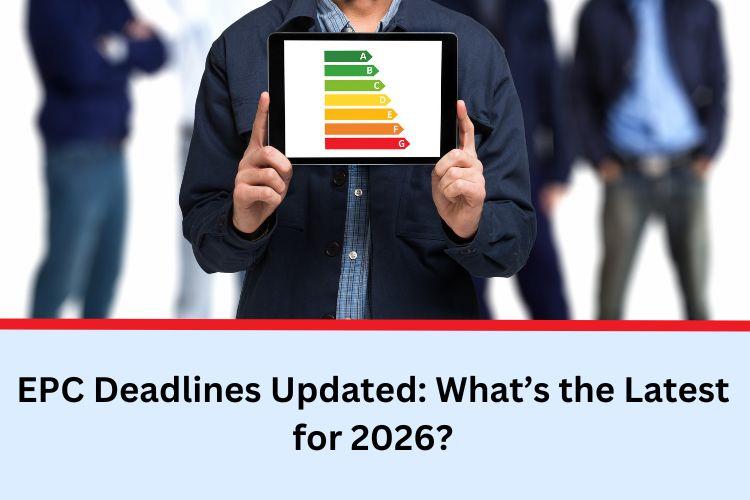
If you’ve completely lost track of what’s happening with EPC rules for landlords, you’re not alone.
Plans to raise minimum energy efficiency standards (MEES) for rental properties from an EPC E rating to a C rating were first announced in 2024, but the deadline for compliance keeps changing.
Thankfully, 2026 has brought more clarity for landlords. Earlier this year, the government confirmed a new single 2030 deadline for compliance, alongside several other important updates.
While 2030 might sound a long way off, many landlords will need to invest in significant upgrades to get their properties up to standard, so it’s never too early to start planning.
In this article, we’ll explain what we now know about the EPC reforms and look at what steps landlords can take to ensure they reach the target on time.
Deadline pushed back to 2030
Earlier this year, the Labour government reintroduced the EPC reforms and set a new single deadline for compliance.
Landlords now have until 1 October 2030 to achieve an EPC rating of Band C or above. This new deadline replaces the old 2025 and 2028 deadlines and will apply to both new and existing tenancies in the private rented sector.
Spending cap reduced
Another change welcomed by landlords is the reduction of the proposed spending cap from £15,000 to £10,000. This means landlords will only be required to spend up to £10,000 on improvements. Once they have spent up to the cap, if the property still does not meet the required standard, they may be able to register for an ‘all improvements made’ exemption. All improvements made from October 2025 will be included within this cap, and low-interest loans will be offered to help fund improvements.
Low-value property spending cap
There will also be an individual spending cap for landlords with low-value properties valued at under £100,000. These properties will be subject to a reduced spending cap equivalent to 10% of the property’s value.
Higher fines
The penalties for non-compliance with EPC rules are also increasing significantly. The maximum amount landlords can be fined for non-compliance is being increased from £5,000 to £30,000 per property, per breach.
EPC assessments are changing too
While the change to MEES has been widely discussed, many landlords don’t realise that the way EPCs are assessed is also changing.
The existing Standard Assessment Procedure (SAP) methodology is set to be replaced by the new Home Energy Model (HEM). The new model is expected to debut at the same time as the government’s Future Homes Standard, an initiative that aims to ensure new homes are built to be energy efficient to support the government’s climate goals.
The new HEM methodology was initially expected to come into effect during the second half of 2026, but this has now been pushed back to late 2027.
Key metrics that HEM will use to assess a property include:
Fabric performance
A new ‘fabric first’ approach will ensure that rental properties have high-performance insulation and glazing. Landlords will no longer be able to use renewable or smart technology to mask the fact that a property is poorly insulated.
Heating system
The efficiency and environmental impact of the property’s heating system will play a bigger role under the new framework.
Smart readiness
The new methodology will also take into account how well a property uses or can support smart energy technology like smart meters and smart heating controls.
Energy costs
The new system is expected to place more emphasis on how affordable the property is to heat and power.
Landlords who have already started making upgrades will be relieved to know that if they achieve Band C now under the current system, this will still count. However, after 1 October 2029, all properties will be assessed under the new HEM system.
What happened to the 2025 and 2028 deadlines?
If it feels like the goalposts keep moving, that's because they do! The deadlines have changed several times over the last few years.
The original deadline required all new tenancies to have a minimum EPC rating of Band C or above by 2025, and existing tenancies to follow a few years later in 2028.
The Conservative government scrapped the 2025 deadline in September 2023. Then, the 2028 deadline was officially dropped in January 2026 in favour of a single deadline that will apply to all tenancies from 2030.
This updated timeline gives landlords more time to prepare and aligns the deadline with the government’s wider environmental strategy, including the Warm Homes Plan and the Future Homes Standard.
Where do I stand if my property already has an EPC C rating?
If your rental property is already rated C or above, this puts you in a strong position. However, it’s worth noting that when the Home Energy Model assessment system comes into effect, your property may not still have the same rating under the new framework.
With this in mind, it’s a good idea to check now when your energy performance certificate expires. All existing EPCs will remain valid for 10 years, even after the new assessment rules come into effect.
If your certificate is due to expire before 2030, it may be worth renewing your certificate under the existing methodology before 1 October 2029 to buy you more time.
What do landlords need to do to reach the target?
According to the NRLA, over 2.5 million rental homes in England currently have an EPC rating below C and will need improvements. At the same time, there’s already a shortfall of skilled tradespeople available to carry out the work, and demand is only expected to increase as the deadline looms.
That means landlords who start planning and making improvements now are likely to be in a much stronger position than those who leave everything until the last minute. Starting now will also help you to spread the cost of improvements, improve tenant satisfaction, and reduce energy bills sooner, win-win.
Here are some practical steps landlords can take now to start moving towards compliance.
Review your EPC or speak with an EPC assessor
Start by reviewing your current EPC certificate and recommendations to identify where the big wins are.
Check if you’re eligible for financial help
Before paying for upgrades yourself, check whether you qualify for any grants, schemes, or financial support. Popular schemes include the Boiler Upgrade Scheme, the Energy Company Obligation (ECO), and the government’s Warm Homes Local Grant and low-cost or zero-interest loans.
Prioritise ‘fabric-first’ upgrades
These types of upgrades have the biggest impact on your EPC rating and are expected to become even more important under the new Home Energy Model (HEM), so it makes sense to start here.
You want to start with low-cost but high-impact upgrades, things like:
- Loft insulation
- Cavity wall insulation
- Double glazing
- Draught-proofing
Remember, any improvements made from 1 October 2025 count towards the £10,000 cap, so make sure you keep your receipts and invoices.
Check how many more EPC points you still need
Once you’ve made all the big fabric improvements, ask an expert to estimate how many more EPC points you need to reach a C rating. This will help you to avoid overspending on unnecessary upgrades.
Consider upgrading the heating system
If you’re still a long way off Band C and your rental has a gas boiler, it could be time to update the heating system.
While upgrading to a newer condensing boiler may help your property to score a C rating under the current rules, you may want to consider thinking more long-term. Making the leap to an electric boiler or, even better, a heat pump could help to futureproof your investment.
Consider renewable energy upgrades
Aside from heat pumps, installing solar panels can also help you score more EPC points and demonstrate ‘smart readiness’ under the new HEM methodology.
Look for small wins
Still looking for ways to reduce your rental’s carbon emissions and boost its energy efficiency? Small changes like switching from standard lightbulbs to LEDs or adding a smart meter could be all it now needs to tip it over into Band C.
Using PaTMa’s Property Manager to stay on top of EPC compliance
Keeping track of EPC deadlines, renovation work, EPC certificates, invoices, and contractor communications can be overwhelming, especially if you’re managing a portfolio of properties.
PaTMa’s Property Manager tool is designed to help landlords stay organised by keeping all property documents, accounts, and communications in one easy-to-manage place.
Whether you’re already upgrading your properties or just starting to plan for the 2030 deadline, PaTMa can help you to stay on top of compliance and reduce day-to-day admin.
Start your free trial today or book a free online demo to see how PaTMa can help you manage your property portfolio more efficiently.