While Making Tax Digital (MTD) came into effect back in April, many landlords are still feeling confused about what information they need to submit to HMRC and when.
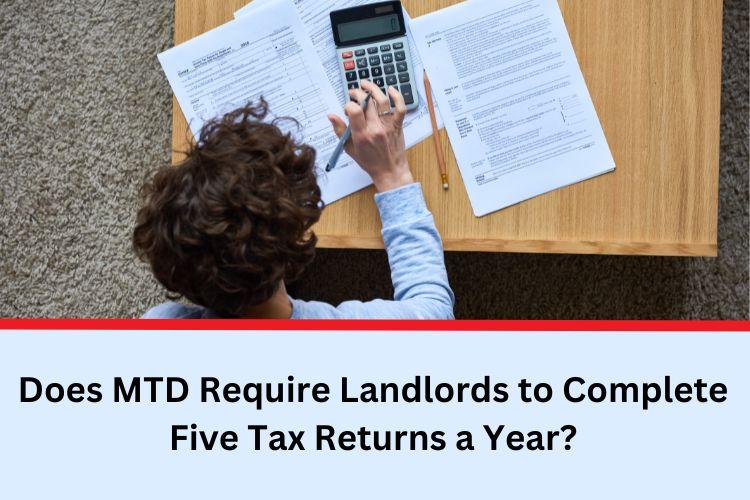
If you’re asking, “Do I now need to submit five tax returns a year to HMRC?” You’re not alone. But the answer (thankfully) is no. Making Tax Digital does not require landlords to submit five full tax returns each year.
This is, in fact, a very common misconception. Landlords are required to provide HMRC with more regular updates, not more full tax returns.
In this article, we aim to clear up any confusion by explaining exactly what information landlords are now required to submit to HMRC and when.
Why do people think landlords need to submit five tax returns a year?
The misconception stems from the fact that Making Tax Digital requires landlords to send four quarterly updates and one annual tax return to HMRC each year. This is not the same as five tax returns.
What do landlords actually need to send to HMRC?
MTD aims to help landlords stay up to date with their bookkeeping by requiring them to submit updates regularly throughout the year.
Rather than submitting one annual self assessment tax return, eligible landlords now need to send information to HMRC at regular intervals. The five submissions during the tax year are made up of:
- 4 quarterly updates
- 1 annual tax return
Let’s take a closer look at what each submission involves.
What do the MTD quarterly updates involve?
The quarterly updates are summaries of your business’s income and expenses. They are not full tax returns, and you do not need to calculate tax liability or pay anything for a quarterly update. They simply provide HMRC with an overview of your finances. Once you have submitted the update, HMRC provides you with an estimate of your tax liability to date.
For landlords using the standard update periods, the quarterly updates cover the following cumulative periods and have these deadlines:
- Quarter 1 (6 April – 5 July) Deadline 7 August 2026
- Quarter 2 (6 April – 5 October) Deadline 7 November 2026
- Quarter 3 (6 April – 5 January) Deadline 7 February 2027
- Quarter 4 (6 April – 5 April) Deadline 7 May 2027
Each update covers the tax year to date, so you can correct your digital records in a later update without having to resubmit earlier ones.
Your MTD-compatible software should automatically categorise and total your records, making it quick and easy to submit your update.
How and when do I submit my annual tax return?
Your annual tax return now needs to be submitted digitally via your MTD-compatible software. It should be sent after your last quarterly submission has been made to confirm your tax position and how much you owe for the year.
Sending your annual tax return is much simpler than submitting a self assessment tax return, because all your financial information has already been submitted to HMRC throughout the course of the year.
Before you submit your tax return, you need to make any required adjustments, claim any reliefs or allowances, and add any other income or gains. Then, simply review and accept the amount that HMRC has calculated based on the information you’ve already provided in your quarterly updates.
The deadline for submitting your annual tax return for the 2026/2027 tax year is 31 January 2028.
When must I pay my tax bill by under MTD?
The deadlines for paying your tax bill have not changed; they remain the same as they were under traditional self assessment.
You must pay any final tax due and any payments on account by 31 January following the end of the tax year, with a second payment on account due by 31 July.
Does Making Tax Digital apply to all landlords?
It’s important to note that MTD doesn’t apply to all landlords yet.
At this moment in time, MTD only applies to landlords with a gross qualifying income of more than £50,000.
It will be rolled out to landlords with a gross qualifying income of more than £30,000 from 6 April 2027 and more than £20,000 from 6 April 2028.
Your qualifying income is your gross income from self-employment and property before expenses.
Does MTD mean more work for landlords?
If you’d previously come to dread the annual tax return and the hours spent compiling and reconciling financial records that it entailed, then MTD should actually make your life easier, not harder.
Yes, it does require you to submit more regular updates to HMRC - but these are not full tax returns. MTD also requires you to use bookkeeping or landlord software to keep digital records, which makes it easier to keep up-to-date and accurate records in real-time. In theory, this should mean that when it’s time to submit your updates to HMRC, you can do so relatively easily, in just a few clicks.
Landlords who weren’t previously keeping digital financial records will also feel the benefit of using software to automate much of the repetitive data entry involved with recording, categorising, and reconciling their financial records.
How does MTD benefit landlords?
Once landlords have got their heads around how to use their software of choice, they should find that rather than creating more work, the new way of working actually offers several valuable benefits.
- Reduce stress: As we’ve learnt above, MTD will help landlords to eliminate that last-minute rush at the year-end, a major cause of stress for many landlords!
- Save time: Although landlords are required to make more frequent submissions, their software should take most of the manual work out of the task. With the majority of the data entry, categorising, and reconciling now automated, all that’s left for the landlord to do is review the figures and make any required adjustments before submitting.
- Clear overview of financial position: Keeping your records up to date gives you a real-time view of your rental income, expenses, and overall portfolio performance, helping you to monitor profitability more effectively and make more informed business decisions.
- Plan and budget accurately for tax bill: Having access to real-time financial data makes it much easier to estimate how much your tax bill is going to be, allowing you to budget for it more effectively and avoid any nasty surprises at the year-end!
Can multiple income sources be included in one MTD submission?
When paying tax, quarterly updates must be submitted separately for each self-employment and property business.
So, if you’re a landlord with multiple UK properties, you don’t need to submit separate quarterly updates for each property, the income and expenses from all your properties should be reported together.
However, if you are both a landlord and self-employed, your property business and your sole trader business should be treated as two separate income sources, with separate MTD updates submitted for each one.
How can landlord software make complying with MTD simpler?
Landlord software like PaTMa Property Manager makes everyday property management more organised and streamlined.
Landlord software uses automation to complete repetitive tasks that can otherwise take up a huge amount of a landlord’s time, particularly bookkeeping and tax preparation.
PaTMa makes complying with MTD effortless by providing tools to help you:
- Record income and expenses in real-time: PaTMa’s Open Banking integration automatically imports your rental income and expenditure straight from your bank account to PaTMa.
- Categorise transactions: PaTMa automatically categorises transactions, saving you time and eliminating human error.
- Receive automated reminders: Set reminders for upcoming compliance and MTD deadlines to make sure you never miss one again.
- Submit quarterly MTD updates to HMRC: PaTMa keeps your financial records up to date in real-time and connects to HMRC, so when the time comes, all you need to do is review your quarterly totals and press submit.
It’s not just your finances that PaTMa can simplify either. It also offers tools to help with compliance, HMO management, and property inventories.
Book a demo or sign up for a free trial to find out more about how PaTMa can simplify MTD compliance and help you manage your property portfolio more efficiently.